DENON DCL-420 Level Controller School Audio 4-CHANNEL
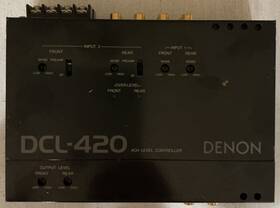
( Brand: Denon ), ( Manufacturer Part Number: DCL-420 ), ( Part Type: Level Controller ), ( Channels: 4-channel )
Review DENON Vintage 4-channel Level Controller Old School Audio Tested
The **Denon DCL-420 4-Channel Level Controller** is a versatile and professional-grade audio management solution designed to meet the precise needs of educational environments, live sound reinforcement, and small-scale performance spaces. Engineered with clarity and reliability in mind, this compact yet robust unit offers four independent channels of precise level control, making it an ideal choice for schools, universities, and community centers where audio quality and flexibility are paramount. Its sleek, minimalist design blends seamlessly into any setup, whether mounted on a wall, placed on a desk, or integrated into a larger audio system. Each of the four channels features a dedicated fader with a smooth, tactile feel, allowing for effortless volume adjustments with minimal effort, while the intuitive front-panel layout ensures quick and intuitive operation even for users with limited technical experience.
Beyond its user-friendly controls, the DCL-420 excels in its technical capabilities, delivering clean, distortion-free signal processing with a dynamic range that preserves the integrity of audio sources. The unit supports both line-level and microphone inputs, accommodating a wide range of audio devices from microphones and instruments to pre-amplified sources like mixers or media players. Its robust construction ensures durability in demanding environments, with sturdy metal construction and high-quality components that withstand frequent use without compromising performance. For added convenience, the DCL-420 includes a built-in headphone output, allowing for private monitoring or troubleshooting without disrupting the main audio feed, while the optional phantom power (48V) on the microphone inputs ensures compatibility with condenser microphones a common requirement in educational settings for clear speech and instrument amplification.
One of the standout features of the DCL-420 is its flexibility in routing and signal management. The unit includes a versatile matrix of outputs and inputs, enabling users to mix, split, or route signals with ease. For example, channels can be summed or routed to a single output for simplified distribution, or individual channels can be isolated for focused control, such as directing a single microphone to a specific speaker or headphone output. This adaptability makes it an excellent tool for classrooms, lecture halls, or performance spaces where audio needs may vary frequently. Additionally, the DCL-420 supports both balanced and unbalanced connections, ensuring compatibility with a wide array of audio equipment, from modern digital interfaces to legacy analog systems. Its compact footprint and low-profile design also make it an unobtrusive yet powerful addition to any audio setup, whether it s tucked away in a teacher s workspace or prominently displayed in a performance area.
For educational environments, the DCL-420 offers practical benefits that enhance both teaching and learning experiences. Its precise level control ensures that audio is consistently clear and well-balanced, whether amplifying a lecturer s voice in a large lecture hall or managing multiple student presentations in a collaborative space. The unit s ability to handle multiple inputs simultaneously reduces the need for complex mixing boards, making it accessible for educators and students alike without sacrificing professional-grade performance. Furthermore, its reliability minimizes downtime, allowing for uninterrupted audio support during lessons, rehearsals, or events. Whether used in a music classroom, a language lab, or a multipurpose auditorium, the Denon DCL-420 delivers the precision, flexibility, and durability required to elevate audio quality in any school setting. With its blend of functionality, ease of use, and professional-grade construction, it stands as a dependable workhorse for audio professionals and educators seeking a straightforward yet powerful solution.
The Denon DCL-420 is a 4-channel level controller designed for school audio systems, offering basic mixing and signal routing capabilities. Below is a detailed breakdown of its pros and cons, followed by a conclusion and recommendation.
---
**Pros:**1. **Affordability**: The DCL-420 is a cost-effective option compared to more advanced digital consoles or high-end analog mixers. It is well-suited for schools with limited budgets, providing essential functionality without excessive expense.
2. **Simplicity and Ease of Use**: The interface is straightforward, with physical knobs and faders that are easy to operate for students, teachers, or audio technicians with minimal training. This reduces the learning curve and makes it accessible for non-professional users.
3. **Analog Signal Processing**: The analog design ensures reliable performance without the risk of digital glitches or software malfunctions. This can be particularly advantageous in educational settings where stability is critical.
4. **Basic Mixing Capabilities**: The 4-channel layout allows for mixing multiple audio sources (e.g., microphones, instruments, or pre-recorded tracks) with individual level control, panning, and basic effects like reverb. This is sufficient for most school events, such as assemblies, performances, or presentations.
5. **Durability**: Denon products are generally built to withstand frequent use, which is important in a school environment where equipment may be handled by multiple users daily.
6. **Compatibility**: The DCL-420 supports standard XLR and TRS inputs/outputs, making it compatible with most microphones, instruments, and audio devices commonly used in schools.
7. **No Software Dependency**: Unlike digital consoles that require computers or tablets, the DCL-420 operates independently, reducing the risk of technical issues related to software or connectivity.
---
**Cons:**1. **Limited Features**: The DCL-420 lacks advanced functionality such as motorized faders, digital signal processing (DSP), or sophisticated routing options. Schools with more complex audio needs (e.g., multi-room distribution, advanced effects, or integration with AV systems) may find it insufficient.
2. **No Motorized Faders**: The faders are manual, which can be tiring during long events or performances. Motorized faders would allow for smoother transitions and easier operation.
3. **No Built-in Effects or DSP**: The lack of onboard effects (e.g., EQ, compression, or dynamic processing) means users must rely on external processors or pre-amplifiers for enhanced audio quality. This adds complexity and cost.
4. **Basic Routing Options**: While the DCL-420 supports mixing, it does not offer advanced routing capabilities such as matrix mixing, sub-mixing, or multi-channel output options that larger systems provide.
5. **No Integration with Digital Systems**: The console does not support digital audio interfaces, network audio, or integration with digital media players or AV systems. Schools using modern digital workflows may need additional hardware or software to bridge the gap.
6. **Limited Input/Output Options**: With only 4 channels, the DCL-420 may not accommodate larger events or multiple simultaneous audio sources without additional mixing or splitting equipment.
7. **No Touchscreen or Remote Control**: The lack of a touchscreen interface or remote control options limits flexibility in operation, especially in larger venues where a single operator may need to control multiple systems.
8. **Outdated Design**: Compared to modern digital consoles, the DCL-420 feels dated in terms of both hardware and software. Schools investing in long-term equipment may prefer more future-proof solutions.
---
**Conclusion:**The Denon DCL-420 is a practical and budget-friendly choice for schools with basic audio needs. Its simplicity, reliability, and affordability make it ideal for small-scale events, classrooms, or assemblies where advanced audio processing is unnecessary. However, its limitations in terms of features, routing flexibility, and integration with modern systems may become a drawback as audio requirements grow or as schools adopt more sophisticated AV setups. If the primary use case involves straightforward mixing of a few sources without the need for advanced effects or digital integration, the DCL-420 is a solid option. For schools anticipating more complex audio demands or planning to expand their systems in the future, investing in a more versatile console such as a digital mixer with motorized faders, DSP, or network capabilities may be a better long-term solution.
---
**Recommendation:** Purchase the Denon DCL-420 if:- Your school s audio needs are simple and involve mixing a small number of sources (e.g., 2-4 microphones or instruments).
- You operate on a tight budget and require a reliable, no-frills solution.
- The equipment will primarily be used for basic events like assemblies, classroom presentations, or small performances.
- You do not require advanced effects, digital integration, or motorized faders.
Consider alternatives (e.g., a digital mixer like the Yamaha QL1, Soundcraft Ui16, or a more advanced analog console) if:- Your school plans to expand audio usage to larger venues or more complex events.
- You need motorized faders, digital signal processing, or integration with digital media players.
- Future-proofing the investment is a priority, and you anticipate growing audio demands.
- You require additional features such as matrix mixing, sub-mixing, or network audio capabilities.
Ultimately, weigh the current needs of your school against potential future requirements to determine whether the DCL-420 aligns with your long-term goals.
Details:
Excellent vintage condition. Unit has been tested for power; the Over Level Leds cycle correctly upon startup. Up for sale is a rare, Japanese-made Denon DCL-420. Sold as-is due to age, but confirmed power on.
It features: Versatile: Handles both Pre-Amp RCA and Speaker-Level inputs. Heavy-duty metal chassis, made in Japan by Nippon Columbia. Perfect for Old School builds using Denon, Alpine, or Camacho gear. This is a premium 4-channel line level controller/pre amplifier from the late 80s/early 90s.
part #: dcl420 price
- $59.99
specifications caramplifieca:
- brand: Denon
- mpn: Dcl-420
- part type: Level Controller
- channels: 4-channel
payments caramplifieca:
- wallet: Google-pay
- other
- credit card: Visa
seller caramplifieca:
- # reviews: 368
- city: Lakewood, Washington
- rating: 100.0%
offer caramplifieca:
- best offers: True
- sold: 0
- started: February 1, 2026
- quantity: 1
- availability: In Stock
- options: Ship-to-home
shipping caramplifieca:
- type: Calculated
- carrier: USPS
- transit: 4-9 Days
- class: Standard
- service: USPS Ground Advantage
- cost: $8.38
general caramplifieca:
- condition: Used
- Vehicle Electronics GPS > Car Audio > Car Amplifiers
returns caramplifieca:
- policy: No Returns
Denon DCL-420 Is Similar To:
- Dca 3150 Denon Amplifier Amp Old School Car Stereo Or Channel (38.5% similar) I bought this new back in the 1990 'S. Actually a very strong little amp. Used but good condition as seen in photos. 4X16 watts but as always with Denon this is understated...(October 13th, 2018)
- Dca-3180 Denon Vintage Dca Stereo Power Car Amplifier (42.5% similar) Vintage Denon DMCA 3180 stereo power amplifier like new condition. Free USPS priority shipping...(August 25th, 2018)
- Dca-500 Denon 2 Channel Bridgeable (33.3% similar) Does a very good job of running component or full-range speakers in stereo 2 channel mode old school sub the mono bridged. 1 used, but great working, old school Denon DMCA channel bridgeable car amplifier. Was missing all of its terminal screws, but I recently replaced them with stainless metric ...(December 4th, 2017)
- Dca 660bl Denon Old School (32% similar) So it is being list as parts only. Features: 1OHM stable, stereo changeable multi-channel power amplifier 2/1 channel extended head-room with uh mos-feat supply variable height-pass and low-pass filter bass boost dc-dc converter soft-start circuit rca balanced inputs outputs remote on off convenient...(January 14th, 2018)
- Dca-3500 Denon Nice Vintage 5 3 Channel Dual Power Amplifier (47.8% similar) Shipping handling charges are for the lower 48 USA only. Nice vintage Denon DMCA channel dual power amplifier in excellent working condition. Shipping buyer agrees to pay amount listed above us dollars to cover packaging and handling...(February 20th, 2016)
- Dca-760bl Denon Professional Car Audio Amplifier (32.8% similar) They don't make amplifiers of this quality any more. Thesis a part of a set that I bought long time ago when I was crazy about quality sound. It is a perfect match for the CD deck that I also have listed. Made in japan, it is very heavy and beautiful to look at. You can imagine the sound that ...(July 13th, 2016)